
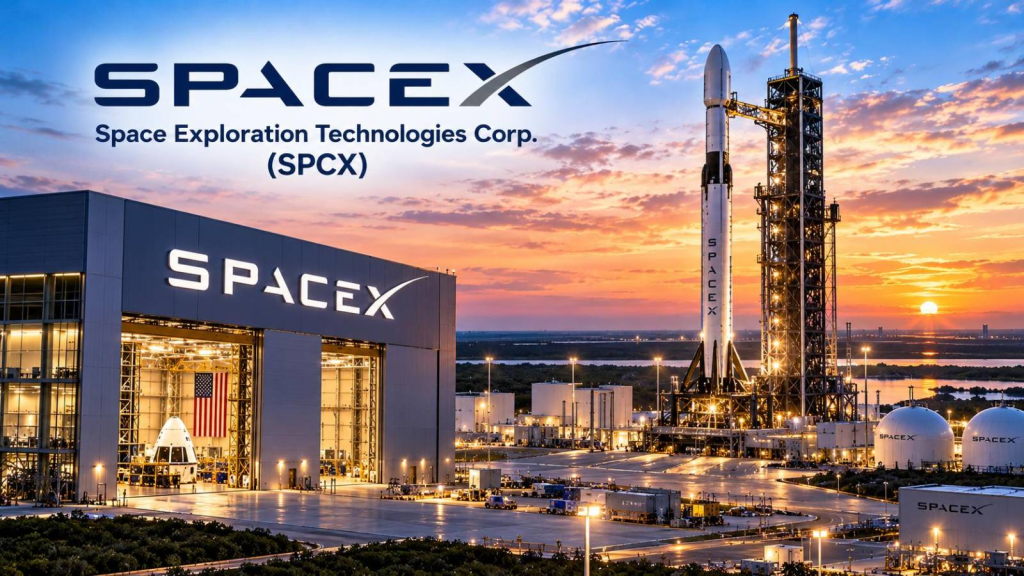
If the market’s understanding of SpaceX over the past decade was mainly built around:
Falcon 9, rocket reusability, and human spaceflight,
then by August 2026, viewing SPCX simply as a “rocket company” would no longer be sufficient.
SpaceX now effectively operates across three major business areas:
Space — Rockets, spacecraft, and space transportation
Connectivity — Starlink satellite internet
AI — Grok, X, and AI computing infrastructure
When these three businesses are viewed together, SpaceX’s business model is gradually shifting from:
“Sending things into space”
toward:
Space transportation + Global connectivity + AI infrastructure.
The timing of August 6 was also particularly important.
SpaceX had gone public less than two months earlier, and on August 4, the company released its first post-IPO Q2 earnings report.
For the first time, the market could evaluate SpaceX through the framework of a public company and gain a clearer understanding of:
how much revenue the company generates,
where that revenue comes from,
and which business areas may become the company’s true long-term growth engines.
Many People Assume SpaceX Mainly Makes Money From Rocket Launches
However, from a financial perspective, the company’s largest business is no longer rockets.
It is:
Starlink.
In 2025, SpaceX’s Connectivity business generated:
$11.387 billion in revenue.
Growth was mainly driven by:
Starlink subscriber expansion,
enterprise customers,
and government connectivity services.
As of March 31, 2026, Starlink had approximately:
10.3 million users
across:
164 countries, regions, and markets.
The company had approximately:
9,600 broadband and mobile satellites in orbit.
The most important transformation at SpaceX is therefore:
In the past, rockets were the product.
Today, rockets are increasingly becoming:
The tool SpaceX uses to build its own global infrastructure.
Why Is Starlink So Important?
Traditional telecommunications companies need to build:
Cell towers, fiber networks, data centers, and terrestrial infrastructure
to provide coverage.
In densely populated cities, this model works effectively.
However, when customers are located in:
mountain regions,
offshore environments,
deserts,
remote rural areas,
or moving vehicles,
building traditional ground-based networks can become extremely expensive.
Starlink operates under a completely different model.
The satellites are already in orbit.
Users only need terminal equipment to access the network.
Therefore, Starlink’s core value is solving the problem of:
Providing connectivity in areas where traditional networks are difficult to deploy.
As the number of satellites increases and coverage expands, the network begins to benefit from significant economies of scale.
The Q2 Data Released on August 4 Made This Trend Even More Visible
As of August 6, the latest available financial information for SpaceX was the company’s second-quarter 2026 results released on August 4.
In Q2, SpaceX reported total revenue of:
$7.814 billion.
Compared with:
$4.071 billion in the same period last year.
This represented approximately:
92% year-over-year growth.
In other words:
Quarterly revenue nearly doubled within one year.
However, the most important point was not simply total revenue growth.
The key question was how much each business segment contributed.
The Largest Segment Was Already Connectivity
In Q2 2026, Connectivity revenue reached:
$4.291 billion.
Compared with:
$2.588 billion in the same period last year.
Within this segment:
Consumer services revenue reached:
$2.485 billion.
Enterprise and government services revenue reached:
$1.806 billion.
These figures highlight an important change.
Starlink is no longer simply:
“Satellite Wi-Fi for households in remote areas.”
It is expanding into:
Aviation
Maritime
Enterprise
Government
Mobile connectivity
Consumer users provide scale.
Enterprise and government customers provide potentially higher-value applications.
Therefore, Starlink’s future market opportunity is not limited to residential broadband.
It is:
Global connectivity infrastructure.
More Importantly, Rocket Business Now Represents Only One Part of SpaceX
In Q2, Space revenue totaled:
$962 million.
Within this segment:
Launch Services revenue reached:
$648 million.
Launch & Development revenue reached:
$314 million.
This creates an interesting situation.
Many investors first recognized SpaceX because of rockets.
However, the core drivers of the company’s future growth are increasingly becoming:
Starlink + AI.
Therefore, the importance of rockets to SpaceX should not only be measured by how much direct revenue they generate.
More importantly:
Rockets allow SpaceX to deploy Starlink infrastructure into orbit using its own launch capabilities.
This Is the Vertical Integration Advantage Behind SpaceX
Imagine a traditional satellite internet company wanting to deploy:
5,000 satellites.
It would typically need to:
Build satellites.
Then find launch providers.
Pay for launch services.
Continue replacing satellites when they reach the end of their operating life.
But SpaceX operates differently.
It:
Builds its own satellites
↓
Builds its own rockets
↓
Launches them itself
↓
Operates its own satellite network
↓
Charges consumers, enterprises, and governments directly
Therefore, Falcon 9 is not only an external launch business generating revenue.
It is also:
The logistics system supporting Starlink’s own infrastructure expansion.
In the First Half of 2026, SpaceX Completed 77 Falcon Launches
By the end of June, SpaceX had completed:
77 Falcon launches
during the first half of 2026.
Among them:
17 customer launches
and
60 internal launches.
The most important point is:
60 launches were internal missions.
A significant portion of their value was not reflected simply through:
“How much revenue did SpaceX generate by selling rocket launches?”
Instead, these launches helped SpaceX continue building its own satellite network.
This is why understanding SpaceX only as a traditional aerospace company misses an important part of its value.
On July 24, Starship Completed Another Important Test
Less than two weeks before August 6, SpaceX conducted:
Starship Flight 13.
This was the second flight test featuring the:
Starship and Super Heavy V3 combination.
More importantly:
It marked the first attempt to deploy next-generation Starlink V3 satellites.
The mission successfully deployed all:
20 Starlink V3 test satellites.
SpaceX also successfully established radio and laser communication with all 20 satellites and collected important telemetry data.
At the same time, the spacecraft completed:
An in-space Raptor engine relight test.
This development was highly important for SPCX on August 6.
Because the real value of Starship is not simply:
“Building a larger rocket for demonstration.”
Its true purpose is solving SpaceX’s own future transportation capacity challenge.
If Starship Succeeds, Starlink’s Expansion Speed Could Change
Falcon 9 is already a highly mature launch vehicle.
However, it still has limitations in payload capacity.
As future Starlink satellites become larger and more advanced, expanding the constellation at a greater scale will require stronger transportation capabilities.
Starship is designed to provide:
Higher payload capacity + Higher launch frequency + Lower marginal launch costs + More complete reusability.
In its IPO materials, SpaceX described Starship as:
A key driver of the company’s long-term growth strategy.
Therefore, Starship should not be viewed only as a spaceflight development project.
It is better understood as:
The heavy-lift logistics system supporting SpaceX’s future commercial ecosystem.
More Surprisingly, SpaceX Now Has a Third Growth Engine: AI
In Q2 2026, SpaceX’s AI business generated:
$2.561 billion in revenue.
Compared with:
$737 million in the same period last year.
Within this segment:
AI Solutions & Infrastructure revenue reached:
$2.194 billion.
Compared with:
$311 million in the same period last year.
This means the segment grew by more than:
6 times year over year.
This is no longer a small or secondary business.
The business structure disclosed after SpaceX’s IPO showed that the AI segment includes:
Grok large language models
AI solutions for consumers and enterprises
The X platform
and
AI computing infrastructure.
Therefore, by August 6, SpaceX had developed a rare combination:
Space + Satellite Connectivity + AI.
Why Is It Interesting to Combine These Three Businesses?
Because they are not completely independent.
Rockets provide:
The ability to deploy infrastructure into space.
Starlink provides:
Global connectivity.
AI provides:
Data processing and intelligent services.
If these three areas can create meaningful synergy in the future, SpaceX’s business model could evolve from simply selling products into providing an integrated platform of:
Computing + Connectivity + Space Infrastructure.
This is also why SPCX should not be evaluated using only the traditional valuation framework applied to aerospace companies.
After the IPO, SpaceX Also Has an Extremely Strong Capital Position
SpaceX’s IPO offering price was:
$135 per share.
The company ultimately issued approximately:
638.9 million shares.
The IPO generated approximately:
$85.675 billion in net proceeds.
In addition, the company completed:
$25 billion in bond financing
in June.
As of the end of June, SpaceX also had:
$5 billion in available credit facilities.
This means SpaceX entered the public market with substantial financial capacity.
At the same time, the company has many areas requiring significant investment:
Starship development
Starlink satellite deployment
AI data centers
Launch infrastructure
and
Future space initiatives
Therefore, the importance of the IPO was not simply:
“SpaceX finally went public.”
More importantly:
The company gained sufficient capital to simultaneously advance multiple highly capital-intensive projects.
However, the Biggest Risk on August 6 Was Valuation
SpaceX went public on June 12 with an IPO price of:
$135 per share.
According to Nasdaq disclosures, the company’s market capitalization reached approximately:
$2.1 trillion
at one point on the first day of trading.
This means the market had already priced in very high expectations for SpaceX’s future growth.
Therefore, when analyzing SPCX, the key question is not simply:
“Is SpaceX a great company?”
That question alone does not provide enough insight.
The more important question is:
“How much future growth has already been reflected in the current valuation?”
A great company and an attractive valuation are not always the same thing.
The Second Risk Is That Starship Has Not Yet Fully Matured
The Flight 13 test on July 24 successfully achieved several important objectives.
However, during the recovery phase, the Super Heavy booster still experienced:
A hard splashdown.
Therefore, Starship remained a system under active development.
A single successful mission achieving key objectives does not mean the system is already capable of operating like Falcon 9 with:
High launch frequency, reliable performance, and low-cost repeat operations.
Many of SpaceX’s long-term growth expectations are closely tied to the eventual success of Starship.
The Third Risk Is That Capital Requirements Will Remain Extremely High
Rockets are not software.
Satellites are not software.
AI data centers are also not software.
SpaceX is simultaneously developing:
Starship + Starlink + AI computing infrastructure.
This means capital expenditure could remain elevated for an extended period.
Therefore, even with rapid revenue growth, investors cannot focus only on:
92% revenue growth.
They must also evaluate:
Capital expenditures, free cash flow, and investment returns.
On August 6, the Real Question Behind SPCX Was No Longer Simply “Will SpaceX Succeed?”
The company had already demonstrated many capabilities.
Falcon had achieved high-frequency launch operations.
Starlink had surpassed the ten-million-user milestone.
Connectivity had become a multi-billion-dollar quarterly revenue business.
AI revenue had also begun expanding rapidly.
Starship had completed the first deployment test of Starlink V3 satellites on July 24.
Therefore, the key question on August 6 had evolved into:
What kind of company will SpaceX ultimately become?
In the past, SpaceX could be described as:
A rocket company.
Later, it became:
Rockets + Starlink.
By 2026, after going public, the company had further evolved into:
Rockets + Starlink + AI.
These three business areas create a unique potential loop:
SpaceX builds its own rockets
↓
Rockets deploy SpaceX’s own satellites into orbit
↓
Satellites create a global communication network
↓
The network connects millions of users and devices
↓
AI processes increasing amounts of data and computing demand
↓
Generated cash continues funding rockets, satellites, and AI infrastructure
This is the core reason why SPCX was worth studying on August 6.
The question was not simply whether the next rocket launch would succeed.
Nor was it only about how many more Starlink users could be added.
The deeper question was:
Can SpaceX combine its space transportation capabilities, global connectivity network, and expanding AI computing capacity into an infrastructure ecosystem that is difficult for other companies to replicate?
If Successful, SpaceX Would No Longer Simply Be Selling Rockets or Connectivity Services
The company’s future ambition goes beyond selling:
A rocket launch service.
It also goes beyond selling:
A Starlink subscription.
What SpaceX is attempting to build is:
An integrated infrastructure platform connecting computing power on Earth, global connectivity, and space transportation.
Over the past decade, SpaceX has continued expanding its role.
At first, the market understood it as:
A rocket company.
Then the story evolved into:
Rockets + Starlink.
By August 2026, after becoming a public company, the business model had expanded further into:
Rockets + Starlink + AI.
These three areas create a potential closed-loop ecosystem:
SpaceX builds launch vehicles
↓
Launch vehicles deploy satellites into orbit
↓
Satellites create a global connectivity network
↓
The network connects users, businesses, and devices worldwide
↓
AI infrastructure processes growing data and computing demand
↓
Revenue generated from these businesses is reinvested into rockets, satellites, and AI infrastructure
This is the core reason SPCX was worth analyzing on August 6.
The key issue was not simply:
Whether the next rocket could launch successfully.
It was not only:
How many additional Starlink users the company could gain.
The more important question was:
Whether SpaceX could successfully combine space transportation capabilities, global connectivity, and expanding AI computing infrastructure into a unified ecosystem that few competitors could replicate.
If this vision becomes reality, SpaceX’s future business would extend beyond:
A ticket to space.
And beyond:
A monthly Starlink subscription.
The company is ultimately attempting to build:
A complete infrastructure system spanning terrestrial computing, global connectivity, and space transportation.
As of August 6, 2026, several developments had already made this direction increasingly visible:
Q2 revenue growth of approximately 92% year over year,
Starlink exceeding ten million users,
Rapid expansion of AI-related business,
and
Starship beginning to validate next-generation Starlink V3 satellite deployment capabilities.
These developments provided a clearer picture of SpaceX’s long-term transformation after its IPO.